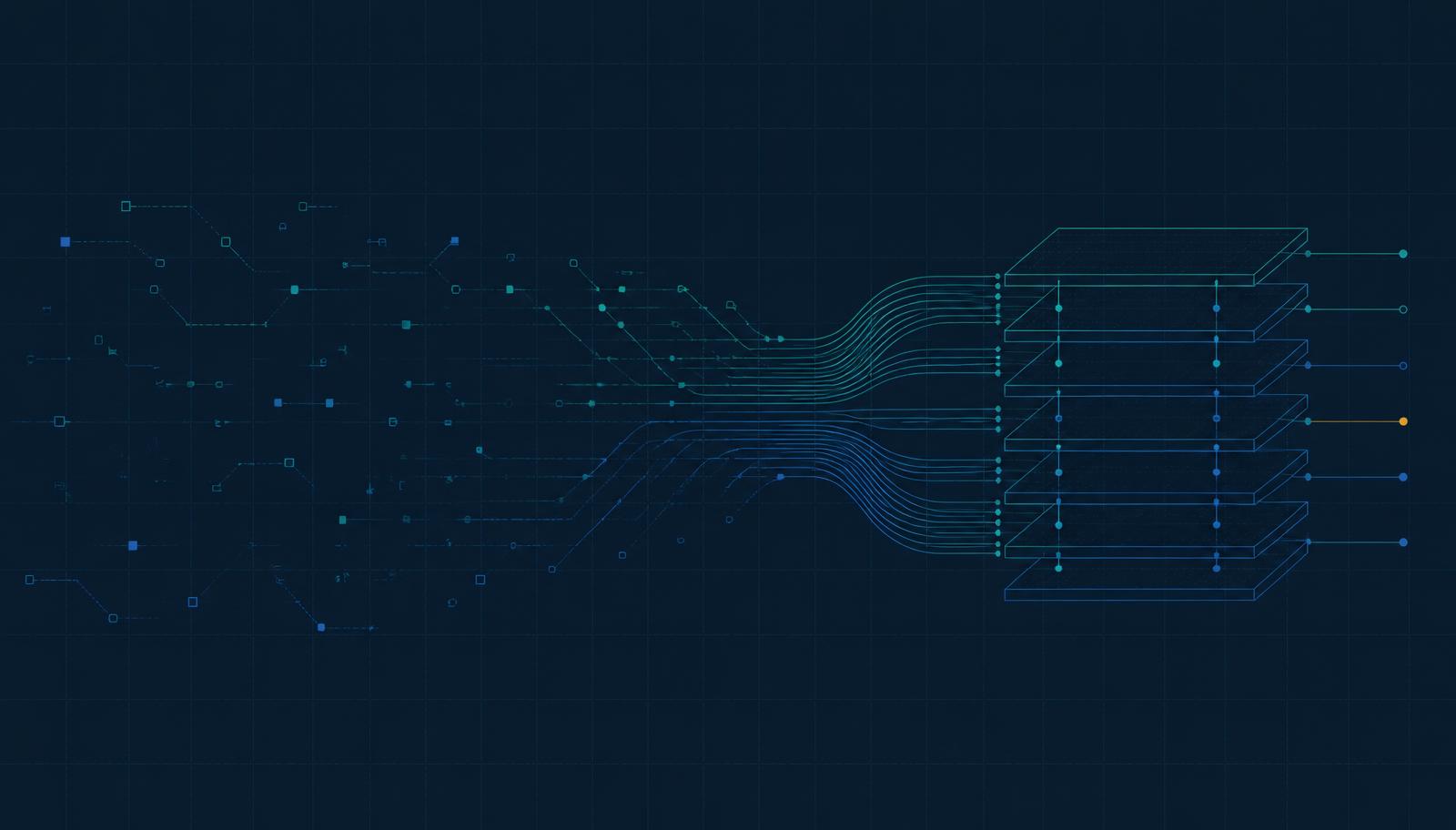
AI has made it surprisingly easy to build things.
A few people in your organisation may already be experimenting with AI. Perhaps someone has built a small internal tool. Someone has automated part of a process. Perhaps your team has created an AI assistant, connected an AI model to some business information, or built a prototype that looks genuinely useful.
That’s a good thing.
You should experiment with AI. You should learn what it can do. You should encourage people to find practical ways of using it.
But there comes a point when the question changes.
It’s no longer:
“Can we make this work?”
It becomes:
“Can we actually rely on this?”
That’s where things start to get more complicated.
A working prototype isn’t a finished system
A prototype is usually designed to prove an idea.
It might work brilliantly with a particular set of information, for a particular person, or in a controlled environment.
A production system has a much bigger job.
It needs to work consistently. It needs to be secure. It needs to connect to the systems your business already uses. It needs to cope with real users and real data.
And someone needs to be responsible for it when something goes wrong.
So what happens after the prototype?
Usually, the questions start appearing.
- Can we connect it to our existing systems?Your AI tool might work perfectly on its own, but your business doesn’t operate on its own. It may need to connect to your CRM, document management system, LMS, ERP, website or other internal applications.
- Can we use real business data?Testing with sample information is one thing. Using customer, employee or commercially sensitive information is another.
- What happens when the AI gets something wrong?AI systems can produce very useful results, but they aren’t infallible. You need to think about when a person should review an output and what happens when the system isn’t confident.
- Can we give it to everyone?A tool that works for three people may need considerable work before it is ready for hundreds of employees, customers or partners.
- Who looks after it?Once people depend on the system, somebody needs to monitor it, fix problems, manage changes and keep it running.
These aren’t reasons not to build with AI.
They’re simply the things that come after the prototype.
This is where many AI projects get stuck
The prototype works.
Everyone is excited.
Then someone asks:
“How do we actually put this into the business?”
And suddenly there are more questions than answers.
- How should it be integrated?
- Where should it run?
- How do we secure it?
- How do we manage access?
- How do we monitor it?
- How do we handle failures?
- How do we make sure the information it uses remains accurate?
The prototype hasn’t failed.
It has simply reached the point where experimentation needs to become engineering.
You don’t have to throw away what you’ve built
This is perhaps the most important point.
If your team has already built something useful, don’t assume you need to start again.
In many cases, the prototype is an excellent starting point.
The next stage may involve reviewing what you’ve built, identifying the gaps and then making it robust enough for real-world use.
That might mean:
Sometimes the changes are relatively straightforward.
Sometimes they aren’t.
The important thing is to understand the gap before committing significant time and money.
When should you bring in professional help?
You don’t need professional services every time somebody experiments with AI.
In fact, I would encourage organisations to experiment.
Try things.
Build small tools.
Learn what works.
Discover where AI can genuinely save time or improve the way people work.
But when something starts showing real business value, that’s usually the point to take a closer look.
Professional expertise becomes particularly valuable when you need to:
- connect an AI solution to existing systems
- use real business or customer data
- make the solution available to more users
- improve reliability
- address security and access
- introduce appropriate governance
- monitor the system in production
- maintain and improve it over time
That’s when a prototype needs to become a production-ready system.
The good news: you may already have done the hardest part
Finding a useful application for AI isn’t always easy.
If your team has already built something that genuinely solves a problem, you’ve made an important start.
You have demonstrated that the idea has potential.
The next question is simply:
What does it need to become something the business can confidently use every day?
You don’t necessarily need another AI experiment.
You may need to take the one you’ve already built and make it work properly.
From working prototype to running system
This is where IntelliMinds Digital focuses its work.
We help organisations take promising AI ideas, prototypes and internal tools and turn them into systems that can operate reliably in the real world.
That can include:
Assess
Understanding the business opportunity, technical requirements and what needs to change.
Build
Developing or refining the application and connecting it to the systems and data around it.
Deploy
Putting it into a secure environment where real users can access it.
Run
Monitoring, supporting and improving the system after it goes live.
We don’t believe every AI experiment needs to become a production system.
But when you’ve built something that genuinely works and creates value, it may be worth taking it further.
Relevant Services
- Prototype to Production — take a working prototype to a secure, monitored production system.
- AI Solution Design — work out what the solution needs to become before you commit budget.
- Custom AI Development — refine and extend what you’ve already built.
- Managed AI Hosting & Support — someone responsible for it once real people depend on it.
Author
Vikram Katyani — Founder, IntelliMinds Digital.
Helping organisations move AI from experimentation into production through practical strategy, custom development and managed AI operations.