
Introduction
One of the questions I'm asked most frequently is:
"Where should we use AI?"
It's a reasonable question.
But interestingly, the organisations that achieve the best results rarely start by looking for AI.
They start by looking for friction.
Where are people wasting time?
Where are decisions delayed?
Where is information difficult to find?
Where are skilled employees spending their day doing repetitive work?
Those are the places where AI usually creates the greatest value.
Not because AI is fashionable.
Because removing friction improves how the organisation operates.
AI Doesn’t Create Problems. It Solves Existing Ones.
Every successful AI project I've been involved with has solved a problem that already existed.
Proposal teams already struggled with repetitive writing.
Support teams already answered the same questions repeatedly.
Operations teams already processed thousands of similar documents.
HR teams already searched across multiple policies.
Sales teams already qualified leads manually.
The AI didn't invent those challenges.
It simply addressed them more efficiently.
That's an important distinction.
If there isn't an existing business problem, AI is unlikely to create meaningful value on its own.
Stop Looking At Departments
Many organisations begin their AI journey department by department.
Sales.
HR.
Finance.
Operations.
Marketing.
IT.
While that seems logical, I actually think it's the wrong perspective.
AI rarely transforms departments.
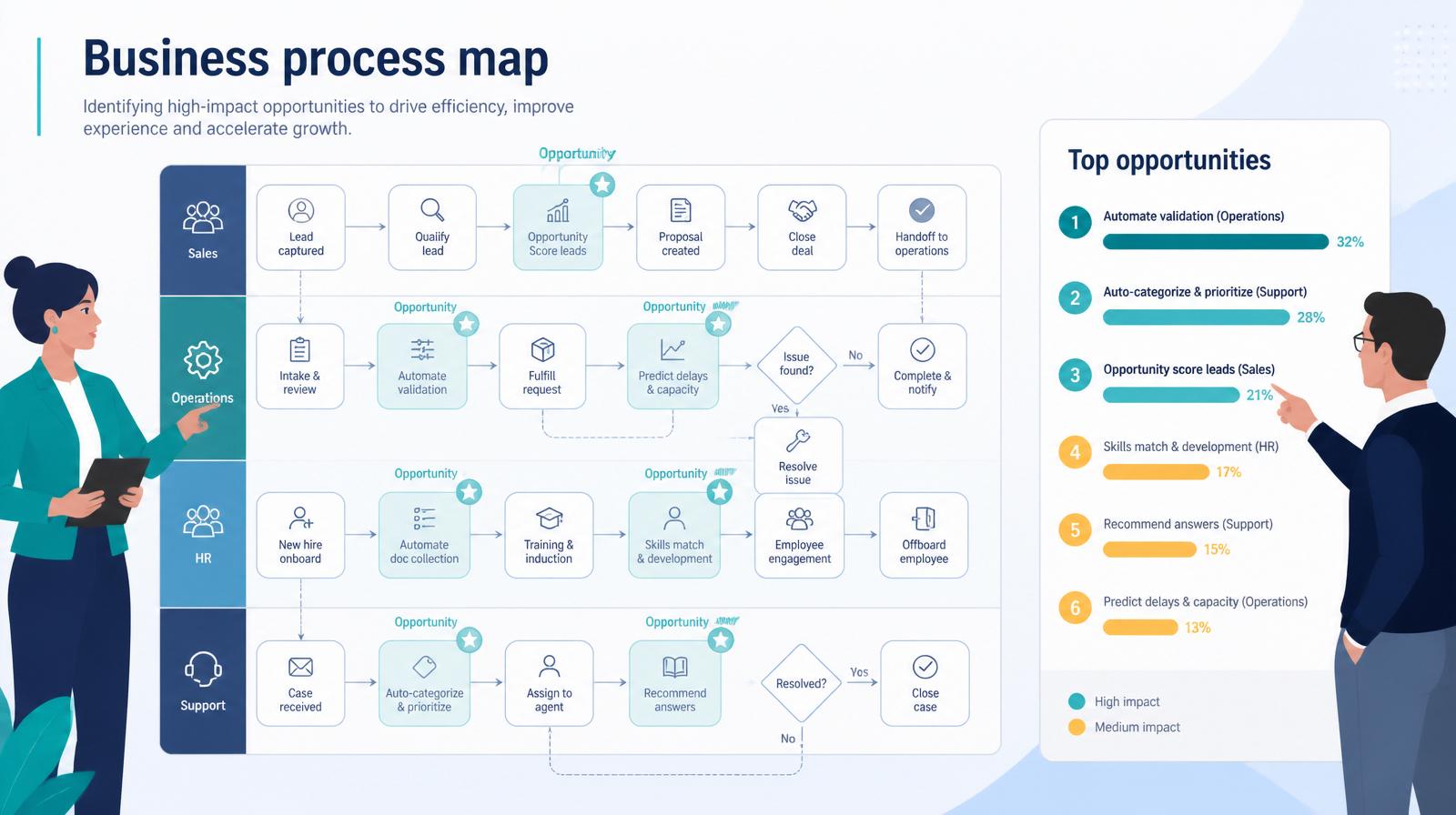
It transforms workflows.
A customer enquiry might involve:
Marketing.
Sales.
Operations.
Finance.
Customer Support.
Instead of asking:
"Where can HR use AI?"
Ask:
"Where does work slow down?"
The answer often spans several teams.
That's where the biggest opportunities usually exist.
Follow The Repetition
One of the easiest ways to identify AI opportunities is surprisingly simple.
Watch for repetition.
Whenever intelligent people repeat the same task dozens or hundreds of times every week, it's worth investigating.
Examples include:
- writing similar emails
- reviewing similar documents
- answering similar questions
- summarising meetings
- searching for information
- checking compliance
- producing reports
- comparing contracts
- analysing proposals
These activities already require judgement.
They're also repetitive.
That's often the ideal combination for AI assistance.
Look For Expensive Time
Not all time has equal value.
Saving five minutes for fifty employees every day can be transformational.
Saving five minutes once a month probably isn't.
One exercise I often recommend is asking:
"Where are our highest-paid people spending time they shouldn't be spending?"
For example:
Senior consultants formatting reports.
Sales directors searching for old proposals.
Engineers writing repetitive documentation.
HR specialists answering identical policy questions.
Operations managers manually reviewing spreadsheets.
These aren't technology problems.
They're time allocation problems.
AI frequently delivers its greatest value by allowing experts to spend more time applying expertise—and less time repeating administrative work.
AI Should Improve Decisions, Not Just Speed
Another common misconception is that AI exists simply to make work faster.
Speed is valuable.
But quality often matters even more.
For example:
An AI assistant helping proposal teams maintain consistent messaging.
A contract review assistant identifying missing clauses.
A knowledge assistant ensuring employees reference the latest policy.
A customer support assistant recommending the correct response.
In each case, AI isn't simply saving time.
It's improving consistency.
Reducing errors.
Supporting better decisions.
Those benefits often create far greater long-term value than speed alone.
The Best Opportunities Are Usually Hidden In Plain Sight
One thing continues to surprise me.
The highest-value AI opportunities are rarely secret.
People already know where the frustration exists.
Ask employees:
"What wastes the most time?"
"What task do you dread every week?"
"What information is hardest to find?"
"What work feels repetitive?"
The answers appear remarkably quickly.
The challenge isn't discovering opportunities.
It's recognising that those everyday frustrations often represent excellent AI use cases.
Where The Biggest AI Opportunities Usually Exist
One of the mistakes organisations often make is assuming AI opportunities are evenly distributed.
They're not.
Some processes naturally benefit from AI.
Others don't.
The goal isn't to apply AI everywhere.
The goal is to identify the relatively small number of workflows where AI creates disproportionate business value.
Those opportunities usually share a number of characteristics.
Information Is Scattered
One of the strongest indicators that AI could help is when employees spend significant time searching for information.
Ask yourself:
- Are people searching across SharePoint, Teams and network drives?
- Do employees regularly ask colleagues where documents are?
- Are there multiple versions of the same file?
- Does important knowledge exist only in experienced employees' heads?
If the answer is yes, there is often an opportunity for an AI-powered knowledge assistant.
The objective isn't simply finding documents faster.
It's helping people make better decisions using trusted organisational knowledge.
Knowledge retrieval is one of the areas where organisations often see immediate productivity gains.
Work Depends On Reading Large Volumes Of Information
Many organisations operate in document-heavy environments.
Examples include:
- proposals
- contracts
- policies
- compliance documentation
- technical specifications
- training materials
- customer correspondence
These documents are valuable.
They're also time-consuming to review.
AI excels at helping people:
- summarise
- compare
- classify
- extract information
- identify inconsistencies
- highlight missing content
Notice something important.
The human still makes the decision.
AI simply reduces the effort required to reach that decision.
Experts Are Doing Administrative Work
One question I often ask clients is:
"What work are your most experienced people doing that someone else could probably do?"
The answers are fascinating.
Senior consultants formatting documents.
Engineers writing repetitive reports.
Sales managers searching previous proposals.
Operations directors reviewing routine spreadsheets.
HR specialists answering identical questions.
These aren't high-value uses of expert time.
AI allows specialists to spend more time applying expertise and less time performing repetitive administration.
That shift often delivers much greater value than simply reducing headcount or speeding up workflows.
Decisions Follow Similar Patterns
AI performs particularly well when organisations make similar decisions repeatedly.
For example:
Does this proposal meet compliance requirements?
Which support article best answers this question?
Which policy applies here?
Which supplier contract contains this clause?
Which training course should this employee complete?
These decisions still require human oversight.
But much of the analysis leading up to those decisions can be significantly accelerated.
AI doesn't replace judgement.
It prepares information so judgement becomes faster and more consistent.
Manual Handoffs Create Delay
Another area worth examining is the movement of work between teams.
Consider how often information is copied from one system into another.
Or how frequently someone waits for another department to provide information.
Examples include:
Sales handing work to Operations.
HR requesting approval from managers.
Support escalating technical queries.
Finance reviewing purchase requests.
Compliance checking documentation.
Every manual handoff introduces delay.
Not every delay requires AI.
But many can be reduced through intelligent automation, workflow orchestration or AI-assisted decision support.
Sometimes the opportunity isn't replacing people.
It's removing unnecessary waiting.
Employees Already Know The Answers
One exercise I encourage organisations to try is remarkably simple.
Spend one day asking employees three questions:
What task takes longer than it should?
What information is hardest to find?
What work do you repeat every week?
Don't ask managers.
Ask the people doing the work.
You'll usually hear the same frustrations repeatedly.
Those recurring frustrations are often much stronger indicators than any external AI trend report.
The best AI opportunities are rarely discovered in boardrooms.
They're discovered in the everyday experience of people trying to get their work done.
Opportunity Mapping Is More Valuable Than Idea Generation
Brainstorming sessions often produce dozens of AI ideas.
Most organisations don't need dozens of ideas.
They need five excellent ones.
That's why I prefer opportunity mapping.
Instead of generating random AI concepts, map:
- business objectives
- operational bottlenecks
- repetitive work
- knowledge challenges
- decision-heavy processes
Then evaluate each opportunity using consistent criteria:
- Business value
- Technical feasibility
- Organisational readiness
- Time to implement
- Expected return
That approach usually produces a much stronger investment roadmap than simply collecting interesting AI ideas.
Because successful AI isn't driven by creativity alone.
It's driven by disciplined prioritisation.
Prioritising AI Opportunities: Which Project Should Come First?
Once organisations begin identifying AI opportunities, they often encounter a different challenge.
Instead of having too few ideas, they suddenly have too many.
Proposal writing.
Customer support.
Internal knowledge.
HR.
Compliance.
Sales.
Finance.
Operations.
Marketing.
Every department can make a compelling case for being first.
The question becomes:
Which opportunity should we invest in first?
Choosing wisely can create momentum across the organisation.
Choosing poorly can slow AI adoption for years.
Not Every Opportunity Has Equal Value
One mistake I frequently see is assuming every AI idea deserves the same level of attention.
It doesn't.
Some projects might save hundreds of hours every month.
Others may only improve a small administrative task.
Some require significant technical integration.
Others can be delivered in a matter of weeks.
The objective isn't simply finding opportunities.
It's identifying the opportunities that create the greatest business impact relative to the effort required.
Successful organisations don't chase every opportunity.
They sequence them.
I Use Four Questions To Evaluate Every Opportunity
Whenever we're helping organisations prioritise AI initiatives, I encourage them to score each opportunity against four simple questions.
1. How Much Business Value Could It Create?
Will it:
- increase revenue?
- reduce operational cost?
- improve customer experience?
- improve employee productivity?
- reduce business risk?
The greater the measurable business outcome, the stronger the opportunity.
2. How Difficult Is It To Implement?
Some projects require:
- multiple system integrations
- complex security reviews
- extensive data preparation
- organisational change
- lengthy testing
Others can be implemented quickly using existing information and modern AI platforms.
Complexity isn't necessarily a reason to avoid a project.
But it should influence when that project begins.
3. Are People Ready To Use It?
This question is often overlooked.
A technically perfect AI system creates very little value if nobody uses it.
Consider:
- Will employees trust it?
- Does it solve a problem they genuinely care about?
- Will managers encourage adoption?
- Does it fit naturally into existing workflows?
Projects with enthusiastic users almost always outperform projects that require people to change behaviour dramatically.
4. Can Success Be Measured?
Every project should begin with a clear definition of success.
For example:
- proposal drafting reduced from six hours to two
- customer response time reduced by 40%
- document review completed twice as fast
- internal search time reduced significantly
- employee satisfaction improved
If success cannot be measured, it becomes very difficult to determine whether the investment was worthwhile.
Think Portfolio, Not Projects
Another helpful mindset is viewing AI as a portfolio of initiatives rather than one large transformation programme.
Instead of betting everything on one ambitious project, organisations build capability over time.
For example:
Phase One
Internal knowledge assistant.
Phase Two
Proposal automation.
Phase Three
Document intelligence.
Phase Four
Customer support assistant.
Each project builds confidence, develops organisational capability and creates reusable components for the next initiative.
The organisation becomes progressively more capable with each successful deployment.
The First Project Should Create Momentum
There's often pressure for the first AI project to be highly visible.
Something exciting.
Something ambitious.
Something that demonstrates innovation.
In reality, I usually recommend the opposite.
Choose the project most likely to succeed.
Early success creates organisational confidence.
Confidence encourages further investment.
Further investment enables larger, more complex initiatives later.
I've seen relatively modest AI assistants completely transform how organisations think about AI simply because they delivered measurable value quickly.
Momentum is far more valuable than headlines.
Beware Of “Shiny Object” AI
The pace of AI innovation is extraordinary.
Every week brings:
- new models
- new platforms
- new announcements
- new capabilities
It's easy to become distracted.
One month everyone is discussing chatbots.
The next it's AI agents.
Then autonomous workflows.
Then multimodal reasoning.
Then something else.
Technology trends change constantly.
Business priorities usually don't.
Organisations that consistently generate value stay focused on solving real operational problems rather than chasing whichever AI capability is currently attracting attention.
Technology should support strategy.
It should never replace it.
Your Best AI Opportunity Might Already Exist
Perhaps the most encouraging thing about AI opportunity identification is this:
You probably don't need to invent anything new.
Your organisation already knows where work is frustrating.
Employees already know which tasks consume too much time.
Managers already know where delays occur.
Customers already know where service could improve.
Those opportunities already exist.
The challenge isn't discovering them.
It's evaluating them objectively and deciding where to begin.
That's exactly what a structured AI Readiness Assessment is designed to achieve.
Instead of asking,
"What could AI do?"
You begin asking,
"Where will AI create the greatest business value?"
That shift in thinking is often where successful AI journeys truly begin.
Bringing It All Together: Turning AI Opportunities Into Business Value
By now, we've explored three important ideas.
First, AI creates the greatest value when it solves real business problems—not when it's implemented because it's fashionable.
Second, the best opportunities are usually hiding inside everyday workflows, repetitive tasks and knowledge-heavy processes.
Third, success depends on choosing the right project—not simply the most exciting one.
That brings us to the final question.
How do you move from a list of opportunities to a practical AI roadmap?
Start Small. Think Long-Term.
One of the biggest misconceptions about AI transformation is that organisations need a large programme before they can begin.
In reality, the opposite is usually true.
The organisations making the fastest progress rarely attempt to transform everything at once.
Instead, they follow a simple pattern:
- Identify one valuable problem.
- Deliver one successful solution.
- Measure the results.
- Learn from the experience.
- Expand into the next opportunity.
Each project strengthens organisational confidence.
Each deployment improves technical capability.
Each success makes the next initiative easier.
AI becomes an evolving business capability rather than a one-off technology project.
Build A Repeatable Framework
Eventually, successful organisations stop thinking in terms of individual AI projects.
Instead, they build a repeatable way of evaluating new opportunities.
For every potential initiative, they ask:
- Does this solve a meaningful business problem?
- Will people actually use it?
- Can success be measured?
- Do we already have the necessary information?
- Is now the right time?
Because the evaluation process stays consistent, decisions become faster and more objective.
This is far more valuable than chasing whichever AI trend happens to dominate the news cycle.
Avoid The “One Big Bet”
I've seen organisations delay AI adoption because they're waiting for the "perfect" project.
The project that will transform the business overnight.
That project rarely exists.
Far more often, competitive advantage is built through a series of smaller improvements.
Perhaps the first project saves the proposal team several hours each week.
The second improves internal knowledge search.
The third reduces customer response times.
The fourth automates document processing.
Individually, each improvement is meaningful.
Together, they fundamentally change how the organisation operates.
Transformation is usually cumulative—not instantaneous.
AI Should Become Part Of Everyday Work
Ultimately, the goal isn't to create an "AI department."
It's to help every department work more effectively.
The most mature organisations rarely describe themselves as "doing AI."
Instead:
Sales prepares proposals faster.
Operations completes workflows more efficiently.
HR answers employee questions more consistently.
Support resolves enquiries more quickly.
Leadership makes better-informed decisions.
AI quietly becomes part of everyday business operations.
That's the outcome organisations should be aiming for.
A Practical Opportunity Checklist
If you're wondering where to begin, try asking these questions across your organisation.
Business
- Which activities consume the most skilled people's time?
- Where do delays affect customers?
- Which processes directly influence revenue?
People
- What work do employees describe as repetitive?
- Which tasks do teams avoid because they're time-consuming?
- Where do people regularly ask colleagues for information?
Information
- Which documents are reviewed repeatedly?
- Where does knowledge exist across multiple systems?
- Which decisions rely on searching through large volumes of information?
Operations
- Which processes involve repeated manual handoffs?
- Which approvals create bottlenecks?
- Which activities occur every day, every week or every month?
Where several of these questions point towards the same workflow, you've probably identified a strong AI opportunity.
Every Organisation Already Has AI Opportunities
Perhaps the most important message from this article is also the simplest.
You don't need to invent opportunities.
They're already there.
Employees experience them every day.
Customers experience them.
Managers experience them.
The challenge isn't discovering them.
It's evaluating them objectively, prioritising them sensibly and implementing them responsibly.
That's why successful organisations spend time understanding their business before selecting technology.
The technology is important.
But clarity comes first.
Key Takeaways
- AI opportunities are usually found inside existing business problems—not new ones.
- The highest-value opportunities often involve repetitive, knowledge-intensive work.
- Prioritisation matters more than the number of AI ideas generated.
- Early successes build confidence for larger AI initiatives.
- AI transformation is usually achieved through a sequence of practical improvements rather than one major programme.
- A structured evaluation process helps organisations invest in the right opportunities at the right time.
Where Should You Begin?
Most organisations don't need more AI ideas.
They need confidence that they're investing in the right one.
That's exactly what our AI Readiness Assessment is designed to provide.
In around five minutes you'll receive:
- An AI Readiness Score
- An assessment across strategy, people, processes, technology, data and governance
- A prioritised view of potential AI opportunities
- Key implementation risks
- Practical recommendations for the best place to begin
Whether you're exploring AI for the first time or planning your next initiative, it provides a structured starting point for making informed decisions.
Continue The Conversation
At IntelliMinds Digital, we help organisations identify, prioritise, build and operate practical AI solutions that deliver measurable business value.
Our services include:
- AI Readiness Assessments
- AI Strategy & Roadmaps
- AI Opportunity Discovery Workshops
- Custom AI Development
- AI Automation
- Prototype to Production
- Managed AI Hosting & Long-term Support
Because successful AI doesn't begin with choosing a model.
It begins with understanding your business.
And that's where the greatest opportunities are usually found.
Related Insights
- Why Every Organisation Needs an AI Readiness Assessment Before Building AI
- The Two Questions Every Organisation Should Answer Before Investing in AI
- From Prototype to Production: Why Most AI Projects Stall After the Demo
- AI Applications Aren't "Build Once, Run Forever"
- Built an AI App in Lovable? Here's What It Really Takes to Run It in Production
Author
Vikram Katyani
Founder, IntelliMinds Digital
Helping organisations identify high-value AI opportunities, build production-ready AI systems and operate them successfully through practical strategy, custom development and managed AI services.
Relevant Services
- AI Readiness Assessment — structured diagnostic of strategy, data, technology, governance and people.
- AI Strategy Consulting — decide where AI investment will and will not pay back.
- Custom AI Development — build the AI workflow, tightly fitted to how your business actually operates.
- Prototype to Production — take a working prototype to a secure, monitored production system.
- Managed AI Hosting — ongoing operation, monitoring and improvement of live AI systems.
Author
Vikram Katyani — Founder, IntelliMinds Digital.
Helping organisations move AI from experimentation into production through practical strategy, custom development and managed AI operations.