Hunt, ask, repeat
- Question
- Search SharePoint
- Search Teams
- Search email and documents
- Ask a colleague
- Still unsure
Employees ask a question in plain English. The assistant searches your approved knowledge sources — SharePoint, Microsoft 365, Confluence, policies and project documentation — and answers with citations.
A 30-minute call. No pitch deck, no slideware. If we can help, we'll tell you how.
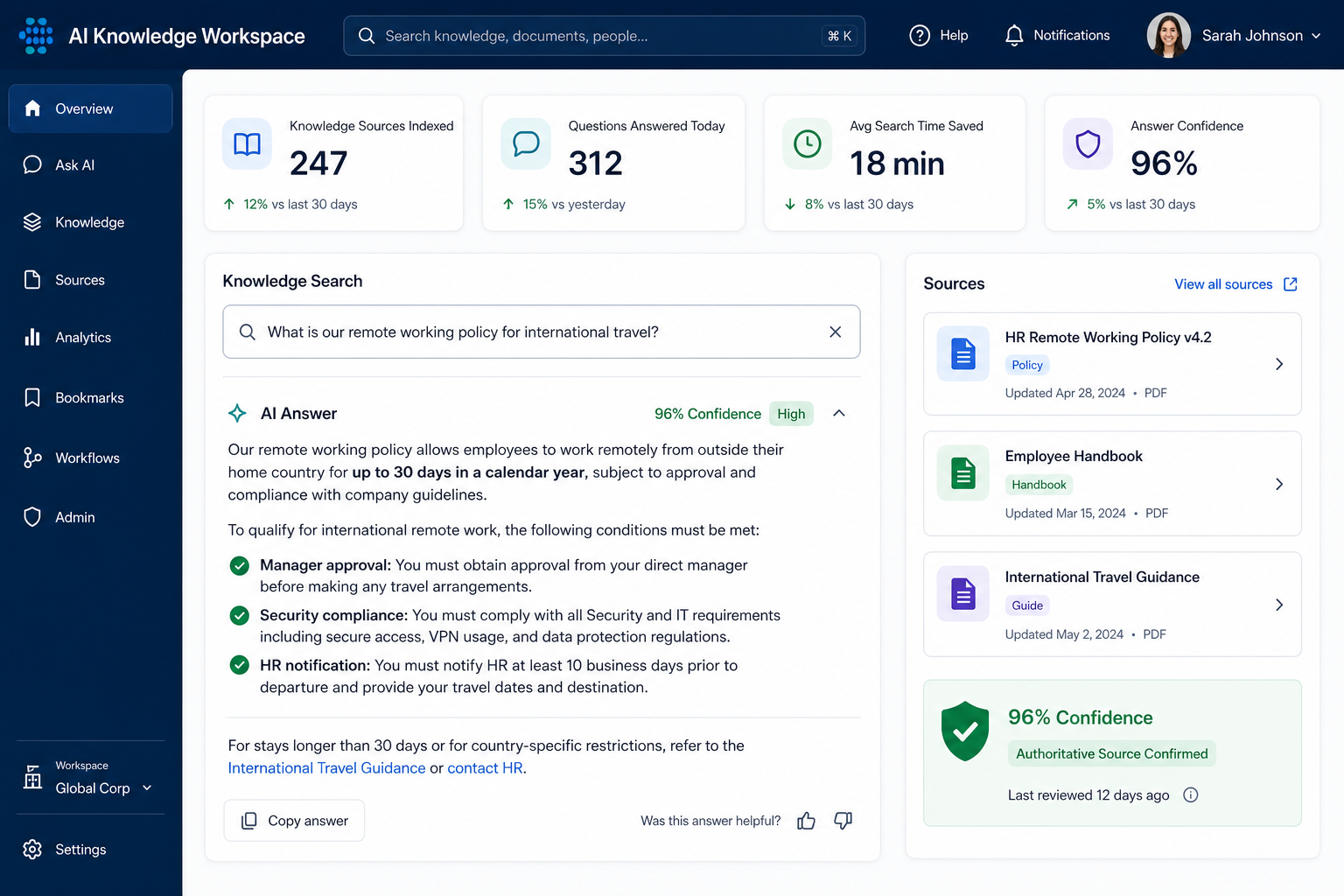
An AI internal knowledge assistant lets employees ask questions in plain English and find answers from the organisation's own approved knowledge sources.
Instead of searching SharePoint, Microsoft 365, Confluence and internal documents separately, employees can ask one question and receive an answer grounded in company information, with citations showing where the answer came from.
A production-grade assistant can also respect existing permissions, manage changing content and operate within the organisation's security and governance requirements — which is where moving from prototype to production usually becomes the real work.
The problem is finding it.
Most companies have written down everything someone needs to know, somewhere — in policies, wikis, decks, old emails, past project files. The problem is finding it. Slack searches return chaos. SharePoint returns 47 results, none of them useful.
“SharePoint returns 47 results, none of them useful.”
Your organisation doesn't necessarily need another place to store knowledge. In many cases the information is already sitting inside SharePoint and Microsoft 365.
The opportunity is to make that knowledge easier to find and use. We connect an assistant to approved organisational knowledge sources while respecting the permissions and security controls you already have in place.
How an employee question flows through the platform — from unified search through source validation to a cited, confidence-scored answer.
Employee question
Asked in plain English from the workspace, Teams or intranet
Knowledge search
SharePoint, Confluence, Microsoft 365 and document stores searched together
Source validation
Permissions, recency and authoritativeness checked before use
AI analysis
Relevant passages reasoned over with confidence scoring
Answer generation
Plain-English response drafted, grounded in retrieved evidence
Citation attachment
Every claim linked back to the document, page and version
Trusted response
Cited answer delivered — or a clear “I don't know” if evidence is thin
We build internal assistants that index your real knowledge sources and answer questions in plain English with citations. Trained carefully on what's current and authoritative; configured to say “I don't know” rather than make things up.
The platform connects to approved knowledge sources such as SharePoint, Microsoft 365, Confluence, document repositories, policies and internal documentation. Rather than generating answers without evidence, the system retrieves relevant information, validates the source and presents an answer with citations.
When reliable information is unavailable, the assistant clearly indicates uncertainty rather than inventing an answer — trusted answers, not educated guesses. The same discipline underpins our AI for customer support work, where evidence-backed responses matter just as much.
Many AI assistants can generate convincing answers. The challenge is ensuring those answers are based on trusted organisational knowledge and supported by evidence.
We build knowledge assistants that prioritise authoritative sources, provide citations and respect existing security and governance requirements — then deploy, host and support them in production.
What a production-grade internal knowledge assistant looks like once it is connected to your real sources and running across the organisation.
Search across multiple knowledge repositories simultaneously from one place.
Every answer is linked back to its source material so it can be checked.
Connects to approved organisational knowledge already living in Microsoft 365.
Analyses policies, procedures and long-form documentation, not just FAQs.
Respects existing user permissions and security controls — users only see what they should.
Prioritises trusted, current and authoritative content; downgrades stale material.
Same question. A very different path from “I need to know this” to “I have the answer.”
New joiners get up to speed faster. Senior people stop being asked the same five questions every week. Decisions get made on what's actually written down rather than on whoever shouted loudest in the meeting.
New employees become productive more quickly, without waiting on a buddy.
Subject matter experts answer fewer repetitive questions and reclaim deep-work time.
Teams rely on documented knowledge rather than assumptions or hallway opinions.
Information becomes easier to find and use — in the flow of work, not after it.
A layered architecture — from your existing knowledge sources through indexing and retrieval into a monitored, governed employee workspace.
SharePoint, Confluence, Teams, policies, handbooks and project documentation.
Indexing, chunking and content preparation with permission metadata preserved.
Retrieval, ranking and grounded answer generation with confidence scoring.
Employee search and question interface, embedded into Teams, intranet or web.
Usage monitoring, feedback capture and content management workflows.
Internal knowledge assistants solve a cross-industry problem — anywhere people spend time hunting for information someone has already written down.
Consultants and delivery teams reusing prior work and methodology.
Policies, course material and learner support across institutions.
Product, network and process documentation for large operational teams.
Programme guidance, safeguarding and grant processes across distributed teams.
Regulated procedures, quality documentation and engineering knowledge.
Engineering runbooks, internal APIs and product knowledge across squads.
See how this fits across the industries we work with and our other AI use cases.
This use case is delivered through our custom ai development work. See also our full services list and other use cases.
Not sure whether your knowledge sources are ready? Start with an AI readiness assessment, or read the AI Executive Guides.
A 30-minute call. No pitch deck, no slideware. If we can help, we'll tell you how. If we can't, we'll point you somewhere that can.