Introduction
Over the past year, I've had conversations with organisations of every size—from businesses taking their first steps with AI to enterprises already running multiple AI applications.
One thing has become increasingly clear.
Almost everyone is asking the same question.
"Where should we start?"
It's a sensible question.
But it's often the wrong one.
Because before asking where to start, organisations should ask something far more important.
"Are we actually ready?"
That single question can save months of wasted effort, avoid expensive mistakes and dramatically increase the chances of delivering meaningful business value.
The Pressure To “Do AI”
Few technologies have generated as much attention as artificial intelligence.
Every week brings new announcements.
New models.
New products.
New success stories.
Boards want AI strategies.
Customers expect innovation.
Competitors are launching AI features.
The pressure to "do something with AI" has become intense.
Unfortunately, pressure often leads to rushed decisions.
Organisations begin searching for AI tools before they've identified business problems.
They purchase software before understanding where value will be created.
They build prototypes before considering governance, data or operational readiness.
The technology isn't the problem.
The sequence is.
Technology Has Become The Easy Part
Only a few years ago, building an AI application required highly specialised expertise.
Today that's changing rapidly.
Tools like Lovable, Cursor, GitHub Copilot and modern AI platforms have dramatically lowered the barrier to entry.
Creating software is no longer the difficult part.
Knowing what to build—and why—has become the real challenge.
I've seen organisations spend months building solutions for problems that weren't particularly important.
I've also seen simple AI automations deliver enormous value because they addressed a genuine operational bottleneck.
The difference wasn't technical capability.
It was clarity.
The Cost Of Starting In The Wrong Place
Imagine an organisation decides customer support should be its first AI initiative.
Development begins.
A chatbot is launched.
Six months later adoption remains low.
Employees still answer most enquiries manually.
Management concludes:
"AI didn't really work for us."
But what if customer support was never the highest-value opportunity?
What if proposal writing could have saved hundreds of hours every month?
What if internal knowledge search was slowing down every department?
What if document processing was consuming thousands of manual hours each year?
Choosing the wrong first project doesn't simply waste budget.
It shapes leadership's perception of AI itself.
That's an expensive lesson.
Readiness Is Bigger Than Technology
When people hear the phrase AI Readiness Assessment, they often imagine an IT audit.
It isn't.
Technology is only one piece of the picture.
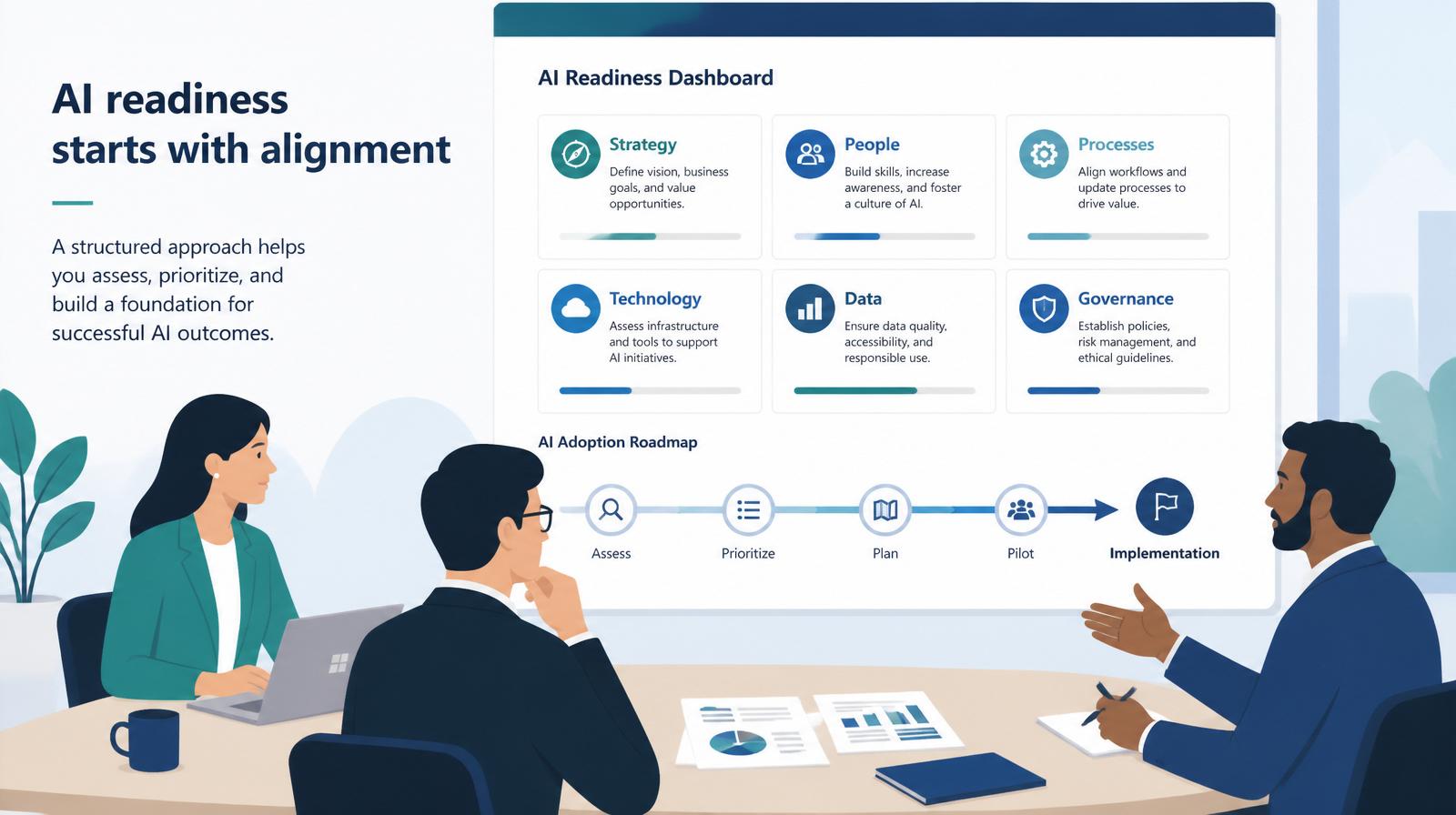
Successful AI adoption depends on several areas working together.
For example:
- Is leadership aligned on priorities?
- Do teams understand where AI creates value?
- Are existing processes suitable for automation?
- Is the necessary data available?
- Are governance responsibilities clear?
- Does the organisation have the capability to operate AI once it's live?
These questions are just as important as selecting a model or cloud platform.
Ignoring them doesn't make them disappear.
It simply delays the conversation until much later—usually when projects become more expensive to change.
Readiness Creates Better Decisions
One of the biggest misconceptions about AI Readiness Assessments is that they're designed to produce more AI projects.
They're not.
In many cases, the best outcome is discovering that an organisation should wait.
Perhaps data quality needs improving.
Perhaps processes require simplification.
Perhaps governance needs strengthening.
Perhaps another digital initiative should happen first.
That's valuable information.
Sometimes the best investment isn't AI.
It's preparing the organisation so AI delivers greater value when the time is right.
Good readiness doesn't accelerate technology.
It improves decision-making.
And better decisions almost always produce better outcomes.
What Does “AI Ready” Actually Mean?
One reason AI readiness is often misunderstood is that people assume it's a technical assessment.
Questions like:
- Which AI model should we use?
- Should we choose Azure or AWS?
- Do we have enough computing power?
- Which vendor should we work with?
Those questions matter.
But they're surprisingly far down the list.
In my experience, the organisations that successfully adopt AI spend far more time understanding their business than choosing their technology.
Technology changes quickly.
Business priorities don't.
Strategy Before Software
Every successful AI initiative I've seen begins with a clear business objective.
Not an AI objective.
A business objective.
For example:
"We want to reduce proposal writing time by 40%."
"We need to respond to customer enquiries more quickly."
"We want our consultants to find internal knowledge instantly."
"We want to reduce manual document processing."
Notice what's missing.
Nobody says:
"We need GPT-5."
Or:
"We need an AI chatbot."
The technology only becomes relevant once the business outcome is understood.
Without that clarity, organisations often end up building impressive demonstrations that solve relatively unimportant problems.
Understanding Your Processes
One of the most valuable parts of any readiness assessment has nothing to do with AI.
It's understanding how work actually happens today.
Every organisation has processes that have evolved over years.
Some are well documented.
Others exist almost entirely through people's experience.
AI works best when those processes are understood.
Questions such as:
- Where does work begin?
- Who makes decisions?
- Which tasks are repetitive?
- Where do delays occur?
- Which information is difficult to find?
- What frustrates employees every day?
Those conversations often reveal opportunities that had never previously been considered.
Sometimes AI becomes the answer.
Sometimes simplifying the process creates even greater value.
Both outcomes are positive.
Data Is More Than Documents
Whenever AI is discussed, someone inevitably asks:
"Do we have enough data?"
Usually they're thinking about documents.
Policies.
PDFs.
Spreadsheets.
Knowledge bases.
Those are certainly important.
But useful AI depends upon much more than document collections.
Organisations should also understand:
- where information lives
- who owns it
- how frequently it's updated
- whether people trust it
- whether different departments use different versions
- how sensitive the information is
An AI assistant can only provide reliable answers if the information behind those answers is reliable.
Poor information doesn't become better simply because AI is involved.
It becomes poor information delivered more quickly.
That's not progress.
People Matter More Than Platforms
Perhaps the most underestimated aspect of AI readiness is people.
Technology adoption has always been about people.
AI is no different.
Questions worth asking include:
Do employees understand why AI is being introduced?
Do they see it as a threat?
Do they trust the outputs?
Will managers encourage adoption?
Who owns the system once it's live?
Who decides what changes?
These aren't technical questions.
They're organisational questions.
Ignoring them often creates more resistance than any technical challenge ever will.
The organisations seeing the strongest adoption are usually those investing as much energy in communication and change management as they do in development.
Governance Should Be Practical
Governance sometimes sounds intimidating.
Policies.
Frameworks.
Committees.
Approval processes.
In reality, good governance is remarkably practical.
It simply answers questions such as:
Who is responsible for this AI system?
What information can it access?
Who approves changes?
How are risks reviewed?
What happens if something goes wrong?
Having clear answers allows organisations to move faster with confidence.
Without governance, every future AI initiative becomes another debate.
With governance, AI becomes another business capability operating within an understood framework.
AI Readiness Isn’t About Passing Or Failing
This is probably the biggest misconception I encounter.
People assume an AI Readiness Assessment produces either:
"Ready."
or
"Not Ready."
That's not how it works.
Every organisation is ready for something.
The real objective is discovering:
- the right first project
- the right level of complexity
- the biggest risks
- the quickest opportunities
- the areas requiring preparation
One organisation may be ready to deploy an internal knowledge assistant within weeks.
Another may benefit more from improving data governance before building anything.
Neither answer is wrong.
The assessment simply helps identify the path that offers the greatest likelihood of success.
That's far more valuable than rushing into development because everyone else appears to be doing the same.
What A Good AI Readiness Assessment Should Deliver
Not all AI Readiness Assessments are created equal.
Some produce a score.
Some generate a lengthy report.
Some recommend buying a particular platform.
In my opinion, a good assessment should do something much more valuable.
It should help an organisation make better decisions.
By the end of the assessment, leadership should have a much clearer understanding of three things:
- Where AI can create the greatest business value.
- What needs to happen before implementation.
- Which initiative should come first.
Everything else is supporting information.
Prioritisation Beats Brainstorming
One of the first things that happens during AI discussions is enthusiasm.
Suddenly every department has ideas.
Sales wants an AI assistant.
HR wants automated onboarding.
Operations wants workflow automation.
Marketing wants AI-generated content.
Customer Support wants a chatbot.
Finance wants document processing.
None of those ideas are necessarily wrong.
The challenge is deciding which one deserves attention first.
Resources are always limited.
Budgets are limited.
Time is limited.
Trying to pursue ten AI initiatives simultaneously usually results in ten incomplete projects.
Successful organisations prioritise.
They deliberately choose the initiative that delivers the highest combination of:
- business value
- implementation feasibility
- organisational readiness
- speed to value
The first successful project creates momentum for everything that follows.
Quick Wins Matter
There's an old saying in digital transformation:
"Success builds belief."
AI is no different.
The first project should rarely be the biggest.
It should be the one most likely to succeed.
That doesn't necessarily mean the simplest.
It means the one where:
- the business problem is well understood
- the data already exists
- users are motivated
- outcomes are measurable
- implementation risk is manageable
Delivering visible value within weeks creates organisational confidence.
People stop asking whether AI works.
They start asking where else it can help.
That shift is incredibly important.
Readiness Should Identify Risks Early
Another purpose of an assessment is identifying obstacles before development begins.
For example:
Perhaps the organisation has excellent opportunities but fragmented data.
Perhaps security policies need updating.
Perhaps responsibilities are unclear.
Perhaps leadership expectations are unrealistic.
Perhaps employees need training before adoption.
Discovering these issues early is far less expensive than discovering them halfway through implementation.
Good readiness isn't pessimistic.
It's preventative.
It allows organisations to prepare before problems become expensive.
Not Every Opportunity Requires AI
One of the most valuable outcomes of an AI Readiness Assessment is sometimes surprising.
The recommendation isn't always AI.
Occasionally the assessment reveals that a process simply needs simplifying.
Perhaps existing software already solves the problem.
Perhaps departments need better integration.
Perhaps documentation needs improving.
Perhaps automation alone delivers most of the value.
This is something I feel strongly about.
Good consulting isn't about recommending AI everywhere.
It's about recommending the simplest solution that achieves the business objective.
Sometimes that's AI.
Sometimes it isn't.
Clients usually remember that honesty.
And in my experience, honesty builds much stronger long-term relationships than unnecessary complexity ever will.
Readiness Creates A Roadmap
The most useful outcome of any readiness assessment isn't a score.
It's a roadmap.
Something practical.
Something leadership can actually use.
A good roadmap answers questions like:
- What should we do first?
- What should wait?
- Which projects depend on others?
- What skills do we need?
- Which risks require attention?
- Where will we see the quickest return?
Without a roadmap, organisations often move from one AI experiment to another.
With a roadmap, each initiative builds naturally on the previous one.
The journey becomes intentional rather than reactive.
The Best AI Strategies Are Surprisingly Simple
It's easy to assume that AI strategy must be complicated.
In reality, the strongest strategies are usually remarkably straightforward.
Solve one important business problem.
Measure the outcome.
Learn from the experience.
Build organisational confidence.
Move to the next opportunity.
Repeat.
That approach may not generate headlines.
But it consistently generates business value.
And that's ultimately what every AI initiative should be measured against.
Technology changes constantly.
Clear priorities rarely do.
AI Readiness Is Really Business Readiness
Perhaps that's the biggest lesson I've learned.
When organisations ask whether they're ready for AI, they're often really asking a different question.
"Are we ready to change how we work?"
Because AI isn't simply another technology investment.
It's a new way of improving decisions, automating work and supporting people.
That requires leadership.
Processes.
Governance.
Communication.
Technology.
All working together.
Seen from that perspective, an AI Readiness Assessment isn't really about assessing AI at all.
It's about assessing how prepared the organisation is to turn new technology into measurable business value.
And that's a much more important question.
Five Signs Your Organisation Is Ready For AI
After speaking with organisations across multiple industries, I've noticed something interesting.
Businesses often assume they're either "AI ready" or "not AI ready."
The reality is far more nuanced.
Readiness exists on a spectrum.
Every organisation is ready for something.
The question is whether they're ready for the right first step.
Here are five characteristics I consistently see in organisations that successfully move from AI ambition to measurable business value.
1. Leadership Has A Clear Business Objective
The strongest AI initiatives rarely begin with technology.
They begin with a business problem everyone agrees is worth solving.
Examples include:
- reducing proposal writing time
- improving customer response times
- helping employees find information more quickly
- reducing repetitive administrative work
- improving consistency across business processes
When leadership is aligned around the outcome, choosing the technology becomes significantly easier.
Without that alignment, AI projects often drift as different stakeholders pursue different priorities.
2. The Organisation Understands Its Processes
AI performs best when the underlying process is already understood.
That doesn't mean the process is perfect.
It means people understand:
- how work currently happens
- where delays occur
- where decisions are made
- where information comes from
- where people lose time every day
If nobody understands today's workflow, asking AI to improve tomorrow's workflow becomes surprisingly difficult.
Many readiness conversations uncover opportunities to simplify the process before introducing automation.
That isn't failure.
It's often the smartest first step.
3. People Are Prepared To Work Differently
Successful AI adoption is rarely about replacing people.
It's about changing how people spend their time.
Employees move away from repetitive administration and towards higher-value work.
Managers begin making decisions supported by better information.
Specialists spend less time searching and more time applying their expertise.
These changes only happen when people understand why AI is being introduced and how it benefits their work.
Communication matters.
Training matters.
Trust matters.
Technology alone doesn't create adoption.
People do.
4. There Is A Plan Beyond Go-Live
One of the questions I always encourage organisations to ask is:
"Who owns this system six months after deployment?"
If nobody knows the answer, the conversation probably isn't finished.
Successful organisations think beyond launch.
They plan for:
- monitoring
- governance
- user feedback
- improvements
- operating costs
- future integrations
- ongoing support
They recognise that AI becomes another operational business system—not a completed project.
That mindset dramatically improves long-term success.
5. Success Can Be Measured
Perhaps the simplest readiness question is also one of the most important.
How will you know the project has been successful?
Can success be measured?
For example:
- Hours saved each week.
- Faster customer response times.
- Increased proposal output.
- Reduced manual processing.
- Higher employee satisfaction.
- Lower operational cost.
Without measurable outcomes, every conversation about AI becomes subjective.
With measurable outcomes, organisations can confidently decide where to invest next.
A Simple Readiness Checklist
If you're considering AI within your organisation, ask yourself these questions.
Strategy
- Do we understand the business problem we're trying to solve?
- Is leadership aligned around that priority?
Processes
- Do we understand how work happens today?
- Have we identified the biggest operational bottlenecks?
Data
- Do we know where our information lives?
- Is it accurate, trusted and accessible?
People
- Do employees understand why AI is being introduced?
- Have we considered training and change management?
Governance
- Do we know who owns the AI system?
- Do we understand security, compliance and responsibility?
Operations
- Do we have a plan for monitoring, improving and supporting the system after deployment?
If several of these questions are difficult to answer, don't worry.
That's exactly why readiness assessments exist.
They're designed to replace uncertainty with clarity.
AI Readiness Is About Confidence
One thing I particularly like about AI Readiness Assessments is that they remove guesswork.
Instead of asking:
"Should we do AI?"
Organisations begin asking much better questions.
Such as:
"Which opportunity creates the greatest value?"
"What's the safest place to begin?"
"What capabilities do we need first?"
"What should we postpone?"
Those conversations almost always produce better outcomes than rushing towards technology because everyone else appears to be doing the same.
Confidence—not speed—is what allows organisations to build AI successfully.
Key Takeaways
- AI readiness is primarily about business readiness—not technical readiness.
- The best first AI project is rarely the biggest project.
- Understanding processes is just as important as understanding technology.
- Leadership alignment dramatically improves project success.
- AI adoption depends on people, governance and operational planning—not just software.
- A structured readiness assessment helps organisations prioritise opportunities, reduce risk and build long-term capability.
Where Should You Begin?
If your organisation is considering AI—or already experimenting with it—the best investment often isn't another prototype.
It's understanding where AI can create the greatest business value.
Our AI Readiness Assessment provides exactly that.
In around five minutes you'll receive:
- An AI Readiness Score
- A structured review across strategy, people, processes, technology, data and governance
- Your highest-value AI opportunities
- Potential implementation risks
- Practical recommendations for the next stage of your AI journey
Whether you're taking your first steps or planning wider AI adoption, it provides a structured starting point for making informed decisions.
Continue The Conversation
At IntelliMinds Digital, we help organisations move beyond AI experimentation by providing practical guidance, production-ready solutions and long-term operational support.
Our work includes:
- AI Readiness Assessments
- AI Strategy & Roadmaps
- Custom AI Development
- AI Automation
- Prototype to Production
- Managed AI Hosting & Long-term Support
Because successful AI isn't about building the most impressive demonstration.
It's about helping organisations create measurable business value—reliably, securely and sustainably.
Related Insights
- The Two Questions Every Organisation Should Answer Before Investing in AI
- From Prototype to Production: Why Most AI Projects Stall After the Demo
- AI Applications Aren't "Build Once, Run Forever"
- Built an AI App in Lovable? Here's What It Really Takes to Run It in Production
Author
Vikram Katyani
Founder, IntelliMinds Digital
Helping organisations move AI from experimentation into production through practical strategy, custom development and managed AI operations.
Relevant Services
- AI Readiness Assessment — structured diagnostic of strategy, data, technology, governance and people.
- AI Strategy Consulting — decide where AI investment will and will not pay back.
- Custom AI Development — build the AI workflow, tightly fitted to how your business actually operates.
- Prototype to Production — take a working prototype to a secure, monitored production system.
- Managed AI Hosting — ongoing operation, monitoring and improvement of live AI systems.
Author
Vikram Katyani — Founder, IntelliMinds Digital.
Helping organisations move AI from experimentation into production through practical strategy, custom development and managed AI operations.