Introduction
Over the past eighteen months, we've witnessed one of the fastest changes in software development I've seen during more than two decades working in technology.
Building software has become dramatically easier.
Today, a founder can describe an idea to Lovable.
An operations manager can build a workflow using Cursor.
A consultant can prototype an internal AI assistant in Replit.
Working software appears within hours.
For many organisations, that's extraordinary.
Ideas that once required months of development can now be explored before lunch.
But after speaking with organisations across different industries, I've noticed something interesting.
Very few conversations are now about building the prototype.
Most conversations begin after the prototype already exists.
They sound something like this:
"The demo went really well."
"Everyone loved it."
"Now we're trying to figure out what comes next."
That "what comes next" is becoming one of the biggest challenges in enterprise AI.
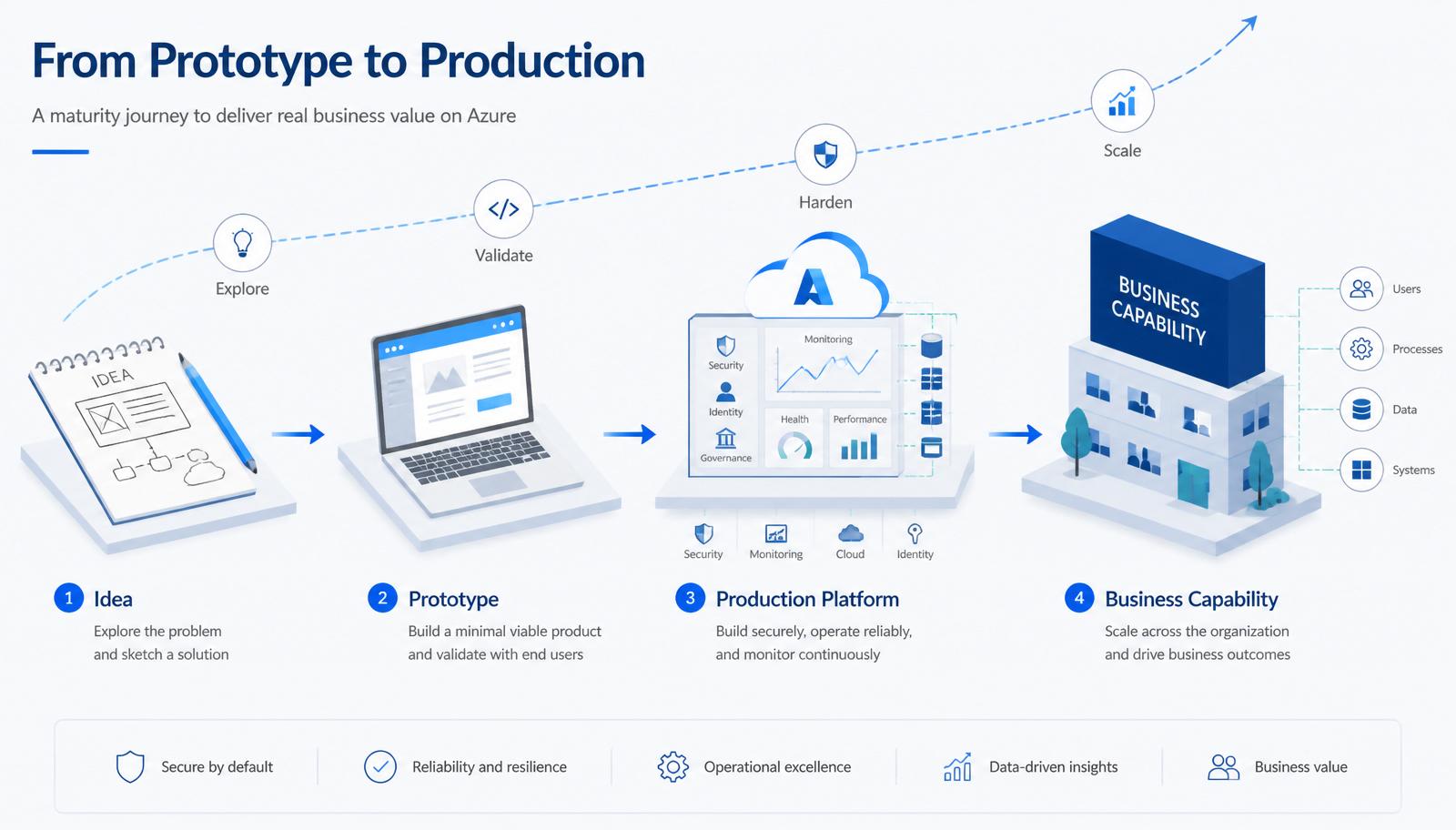
Because moving from a successful demonstration to a trusted production system is not simply another phase of development.
It's an entirely different discipline.
The Demo Was Never the Destination
One of the unintended consequences of modern AI tooling is that organisations can mistake momentum for progress.
When something works quickly, it feels close to completion.
A prototype generates excitement.
People start imagining new possibilities.
Senior leadership becomes interested.
The project gains visibility.
All of that is positive.
But a successful demonstration proves only one thing:
The idea has potential.
It doesn't prove the business can depend on it.
Imagine demonstrating an AI assistant that summarises customer support tickets.
The responses are accurate.
The interface looks polished.
The meeting ends with enthusiastic feedback.
Now ask a different set of questions.
- Can hundreds of support agents use it simultaneously?
- Can it authenticate against your existing identity provider?
- Can it handle sensitive customer information securely?
- Can it be monitored?
- Can it be updated safely?
- Can it survive a cloud outage?
- Can someone support it at 9:00 on a Monday morning?
Those questions determine whether the prototype becomes part of everyday operations.
Not the demonstration.
Why Organisations Get Stuck
Interestingly, most organisations don't fail because the AI doesn't work.
They stall because they reach a point where software development intersects with operational reality.
That's where entirely new conversations begin.
Infrastructure.
Security.
Governance.
Compliance.
Support.
Ownership.
Budget.
Risk.
Many innovation teams simply haven't had to think about these questions during the prototype phase.
Nor should they.
The purpose of experimentation is learning.
The purpose of production is reliability.
Those are different objectives requiring different ways of thinking.
Unfortunately, organisations often assume that one naturally follows the other.
In reality, there's a significant gap between them.
I sometimes refer to it as the deployment gap.
It's the space between:
"We proved AI can solve this problem."
and
"Our business now depends on this system every day."
Bridging that gap has very little to do with prompts or language models.
It has everything to do with engineering, governance and operational excellence.
The Hidden Work Nobody Budgets For
Every successful AI prototype creates optimism.
That's exactly what it should do.
Someone demonstrates a new way of answering customer queries.
A proposal assistant produces a first draft in seconds.
An internal knowledge assistant finds documents that previously took minutes to locate.
The business begins imagining what could happen if the solution were rolled out across the organisation.
Momentum builds quickly.
Ironically, that's often the moment when progress begins to slow.
Not because the AI has stopped working.
Because the project has reached a completely different stage.
The innovation phase is over.
The operational phase has begun.
And operational work is rarely as visible—or as exciting—as the prototype itself.
The Hidden 80%
Building the application often represents only a fraction of the work required to create a dependable business system.
The remaining effort sits beneath the surface.
Users never see it.
Executives rarely ask about it.
Yet without it, the application rarely survives long-term.
Consider everything that must now happen.
- Someone needs to provision production infrastructure.
- Security teams need to review access controls.
- Authentication must integrate with existing identity providers.
- Data policies need to be agreed.
- Monitoring has to be configured.
- Backups need to be tested.
- Support processes need defining.
- Updates require deployment pipelines.
- Someone needs to decide who owns the application.
None of this changes what the AI can do.
But every one of these activities determines whether the organisation can trust the solution enough to depend on it.
It's remarkably similar to constructing a building.
The prototype is the architect's visualisation.
Production is the foundations, structural engineering, utilities, fire protection and ongoing maintenance.
Most of the work is invisible.
That's precisely why it matters.
Why Prototypes Create False Confidence
Modern development tools have dramatically shortened the distance between idea and demonstration.
That's one of the reasons they're so exciting.
But they can also create an unintended illusion.
Because building something has become easier, organisations naturally assume operating it will be equally straightforward.
Unfortunately, those are very different challenges.
A prototype answers one question.
Can this work?
Production asks dozens of others.
- Can we trust it?
- Can we secure it?
- Can we support it?
- Can we monitor it?
- Can we afford it?
- Can we govern it?
- Can we explain it?
- Can we improve it?
Those questions don't reduce the value of rapid prototyping.
They simply remind us that demonstrations prove possibility.
Operations prove sustainability.
Shipping Software Is Not The Same As Operating Software
One distinction I often make with clients is the difference between delivery and operations.
Delivery focuses on creating the application.
Operations focuses on everything that happens afterwards.
It's the difference between opening a new restaurant and successfully running it every day.
Anyone can design an attractive menu.
Running the restaurant means:
- ordering ingredients
- training staff
- maintaining hygiene
- handling suppliers
- monitoring quality
- serving customers consistently
The menu isn't the business.
The operation is.
AI applications follow exactly the same principle.
The language model isn't the solution.
It's one component inside a much larger operational system.
Successful organisations recognise that very early.
Why Momentum Is Lost
When AI initiatives stall, it usually isn't because leadership has lost interest.
More often, the project has entered unfamiliar territory.
Innovation teams suddenly find themselves working with:
Infrastructure engineers.
Security specialists.
Compliance teams.
Operations managers.
Business owners.
Legal teams.
Finance.
Everyone is asking sensible questions.
Collectively, however, those questions can make progress feel dramatically slower than during the prototype phase.
That's completely normal.
In fact, it's often a positive sign.
The organisation has stopped asking:
"Can we build this?"
It's now asking:
"Can we rely on this?"
Those are exactly the conversations that should happen before production.
The mistake is interpreting slower progress as failure.
In reality, the project is maturing.
The work has simply changed.
The Organisations That Succeed Think Differently
The organisations achieving the greatest value from AI aren't necessarily building more sophisticated models.
They're becoming better operators.
They understand that production isn't an event.
It's a capability.
They expect AI systems to evolve.
They invest in governance.
They build monitoring into every deployment.
They plan for model updates.
They define ownership from day one.
Most importantly, they recognise that AI applications are now part of their business infrastructure—not isolated innovation projects.
That shift in thinking changes everything.
Instead of celebrating deployment as the finish line…
They see deployment as the moment the real value begins.
Building Capability, Not Just Applications
One of the biggest differences I see between organisations that succeed with AI and those that struggle isn't technical expertise.
It's mindset.
Successful organisations don't think in terms of AI projects.
They think in terms of business capability.
At first glance, those ideas sound similar.
They're not.
A project has a finish line.
A capability continues to evolve.
When organisations view AI as a project, the objective becomes delivery.
Build the assistant.
Launch the chatbot.
Deploy the automation.
Move on to the next initiative.
Success is measured by whether the application was delivered.
When organisations view AI as a capability, the questions change completely.
- How do we improve it?
- What have users learned?
- Where can we remove more friction?
- Which new workflows should be automated next?
- How do we maintain trust?
- How do we ensure the system continues creating value six months from now?
That's a fundamentally different way of thinking.
It's also the difference between organisations that repeatedly experiment with AI and those that steadily build competitive advantage.
The Best AI Is Often Invisible
There's a common assumption that successful AI should be obvious.
People imagine conversational interfaces, impressive demonstrations and futuristic experiences.
Yet some of the most valuable AI systems I've encountered are almost invisible.
Employees barely think about them.
The technology simply becomes part of how work gets done.
- A proposal manager receives a high-quality first draft before writing begins.
- A support adviser instantly finds the correct policy document.
- A compliance administrator no longer spends hours categorising training content.
- A sales team receives qualified opportunities instead of manually reviewing hundreds of enquiries.
None of these examples feel dramatic after a few weeks.
That's precisely the point.
The technology disappears.
The business outcome remains.
In my experience, that's where AI creates its greatest value.
Not when people talk about it.
When they stop noticing it because it simply works.
AI Doesn't Replace Good Business Processes
Another misconception surrounding AI is that it somehow fixes inefficient processes automatically.
It doesn't.
If a process is poorly understood, poorly owned or unnecessarily complex, introducing AI usually amplifies those problems rather than solving them.
AI performs best when organisations already understand:
- how work flows
- where decisions are made
- who owns each stage
- what success looks like
- where delays occur
Only then can AI improve the process.
This is one reason discovery work remains so important.
The most valuable conversations rarely begin with:
"What model should we use?"
They begin with:
"Walk me through how this work happens today."
Those discussions often reveal opportunities that have very little to do with artificial intelligence.
Sometimes simplifying a workflow delivers more value than automating it.
Sometimes connecting two existing systems removes more effort than introducing another AI model.
Good consulting isn't about recommending AI at every opportunity.
It's about identifying the simplest approach that delivers measurable business value.
Sometimes AI is the answer.
Sometimes it isn't.
Being honest about that builds much stronger long-term relationships.
The Human Workflow Still Matters
Whenever AI enters a business process, people naturally focus on the model.
How accurate is it?
Which provider should we use?
How quickly does it respond?
Those are important questions.
But they're rarely the most important ones.
Equally important is understanding what happens before and after the AI produces an answer.
- Who reviews it?
- Who approves it?
- Who acts upon it?
- What happens if it's wrong?
- How does someone provide feedback?
- Can the system learn from that feedback?
These workflow questions determine whether AI becomes genuinely useful.
For example, an AI-generated proposal draft is valuable because an experienced bid manager reviews, improves and submits it.
The AI accelerates expertise.
It doesn't replace it.
Similarly, an AI assistant supporting customer service should help advisers respond more quickly and consistently.
The final customer interaction still belongs to the adviser.
This concept—often described as human-in-the-loop—isn't a temporary compromise.
For many enterprise applications, it's simply good design.
The objective isn't removing people.
It's enabling people to focus on the decisions where their judgement creates the greatest value.
Technology Changes. Principles Don't.
One reason organisations become overwhelmed by AI is the speed at which the technology evolves.
Every month brings:
- new models
- new tools
- new providers
- new announcements
- new benchmarks
Trying to keep up with every development is exhausting.
Fortunately, you don't need to.
Because while technology changes rapidly, the principles of building dependable business systems remain remarkably consistent.
Understand the business problem.
Design around people.
Protect data.
Monitor performance.
Measure outcomes.
Improve continuously.
Those principles existed long before generative AI.
They'll still matter long after today's models have been replaced by tomorrow's.
That's why I believe organisations should invest less energy in chasing every new AI announcement and more energy in building strong operational foundations.
Technology will continue evolving.
Good engineering and good business thinking never go out of fashion.
AI Is Becoming Part of Everyday Operations
Perhaps the biggest change we'll see over the next few years is that AI will gradually stop being viewed as something separate.
It will simply become another part of everyday operations.
Exactly as cloud computing did.
Exactly as mobile technology did.
Exactly as digital collaboration tools did.
The organisations that prepare for that future won't be those with the largest number of AI experiments.
They'll be those that quietly build reliable, well-governed AI capabilities into the way their business already operates.
That's where long-term value is created.
Not through constant experimentation.
Through consistent execution.
Five Characteristics of Organisations That Successfully Move Beyond the Prototype
After working with organisations building digital platforms for more than two decades—and more recently helping businesses adopt practical AI—I've noticed that successful AI programmes have surprisingly little in common with the technology itself.
Instead, they share a number of organisational characteristics.
They Start With Business Outcomes
Successful organisations don't begin with:
"How can we use AI?"
They begin with:
"Which business problem is worth solving?"
The technology follows the problem—not the other way around.
Whether the objective is reducing bid-writing time, improving customer support, accelerating compliance, or helping sales teams qualify opportunities, the outcome is always defined first.
AI is simply one of the tools used to achieve it.
They Build Small Before Scaling
Very few successful AI programmes begin with organisation-wide transformation.
Instead, they start with something manageable.
One team.
One workflow.
One measurable outcome.
A successful first deployment creates confidence.
Confidence creates momentum.
Momentum creates organisational support.
Only then does wider adoption become easier.
The organisations seeing the greatest success aren't necessarily moving fastest.
They're moving deliberately.
They Treat AI Like Any Other Business System
Once an AI application becomes part of daily operations, expectations change immediately.
Users no longer care how innovative it is.
They simply expect it to work.
That means applying the same standards expected of every other business-critical platform:
- availability
- reliability
- security
- governance
- monitoring
- documentation
- support
The novelty disappears.
Operational excellence remains.
They Expect Continuous Improvement
AI is not a one-time implementation.
Business priorities evolve.
Processes improve.
Employees discover better ways of working.
Language models continue advancing.
Successful organisations expect their AI systems to evolve alongside the business.
Instead of asking,
"When will the AI project finish?"
they ask,
"What's the next improvement?"
That shift creates long-term value rather than short-term excitement.
They Build Internal Confidence, Not Just Better Technology
Perhaps the most overlooked characteristic of successful AI adoption is trust.
Employees need confidence that the system is reliable.
Managers need confidence that outcomes can be measured.
Leadership needs confidence that governance is in place.
Customers need confidence that data is handled responsibly.
Without trust, adoption slows.
With trust, AI quietly becomes another part of everyday work.
Building that trust is rarely about choosing a better language model.
It's about designing better systems.
A Simple Question
Whenever I meet organisations exploring AI, I often ask one question.
"If this application became business-critical tomorrow, would your organisation be comfortable relying on it?"
It's a surprisingly revealing conversation.
Sometimes the answer is an immediate yes.
More often, there's a pause.
Not because the prototype isn't good.
Because people realise there are questions they haven't yet asked.
Questions around ownership.
Support.
Monitoring.
Security.
Governance.
Integration.
None of those questions reduce the value of the prototype.
They simply recognise that dependable business systems require more than working software.
From Prototype to Capability
The democratisation of AI development is one of the most exciting changes our industry has experienced.
More people can build software than ever before.
More ideas can be tested.
More innovation can happen.
That's unquestionably a good thing.
But the organisations that create lasting value won't be remembered because they built the fastest prototype.
They'll be remembered because they successfully embedded AI into the way their business operates.
Quietly.
Reliably.
Securely.
At scale.
The future belongs not to organisations experimenting with the most AI.
It belongs to organisations operating AI exceptionally well.
Key Takeaways
- A successful demonstration is the beginning—not the end—of an AI journey.
- Most AI initiatives stall during the transition from experimentation to operational deployment.
- Operational capability matters more than technical novelty.
- AI delivers the greatest value when it becomes an invisible part of everyday work.
- Building organisational confidence is just as important as building the application itself.
- Long-term success comes from continuous improvement rather than one-off implementation.
Where Should You Begin?
If your organisation has already built a prototype—or is considering its first AI initiative—the next question isn't:
"Which model should we use?"
It's:
"Are we ready to move from experimentation to production?"
That's exactly why we created the AI Readiness Assessment.
In around five minutes, it provides:
- An overall AI Readiness Score
- A structured review across strategy, people, processes, technology, data and governance
- High-value opportunities for AI adoption
- Potential implementation risks
- Practical recommendations for the next stage of your journey
Whether you're evaluating your first AI opportunity or preparing to deploy an existing solution, it provides a clear starting point for the conversations that matter most.
Continue the Conversation
At IntelliMinds Digital, we help organisations bridge the gap between successful prototypes and dependable production systems.
From AI readiness and strategy through to custom development, deployment and long-term operational support, our focus is simple:
Helping organisations build AI capabilities they can rely on every day—not demonstrations that are forgotten after the meeting ends.
Relevant Services
- AI Readiness Assessment — structured diagnostic of strategy, data, technology, governance and people.
- AI Strategy Consulting — decide where AI investment will and will not pay back.
- Custom AI Development — build the AI workflow, tightly fitted to how your business actually operates.
- Prototype to Production — take a working prototype to a secure, monitored production system.
- Managed AI Hosting — ongoing operation, monitoring and improvement of live AI systems.
- AI Automation — automate repeatable operational workflows end to end.
Author
Vikram Katyani — Founder, IntelliMinds Digital.
Helping organisations move AI from experimentation into production through practical strategy, custom development and managed AI operations.