Lead prioritisation challenges
Teams struggle to identify high-intent opportunities. SDRs work through inbound lists with no reliable signal of who's likely to close.

Modern sales teams generate enormous amounts of valuable information through calls, emails, CRM activity, proposals and account interactions. Most of it remains underused. We help B2B sales organisations turn sales data into practical intelligence that improves qualification, forecasting, proposal quality and sales execution.
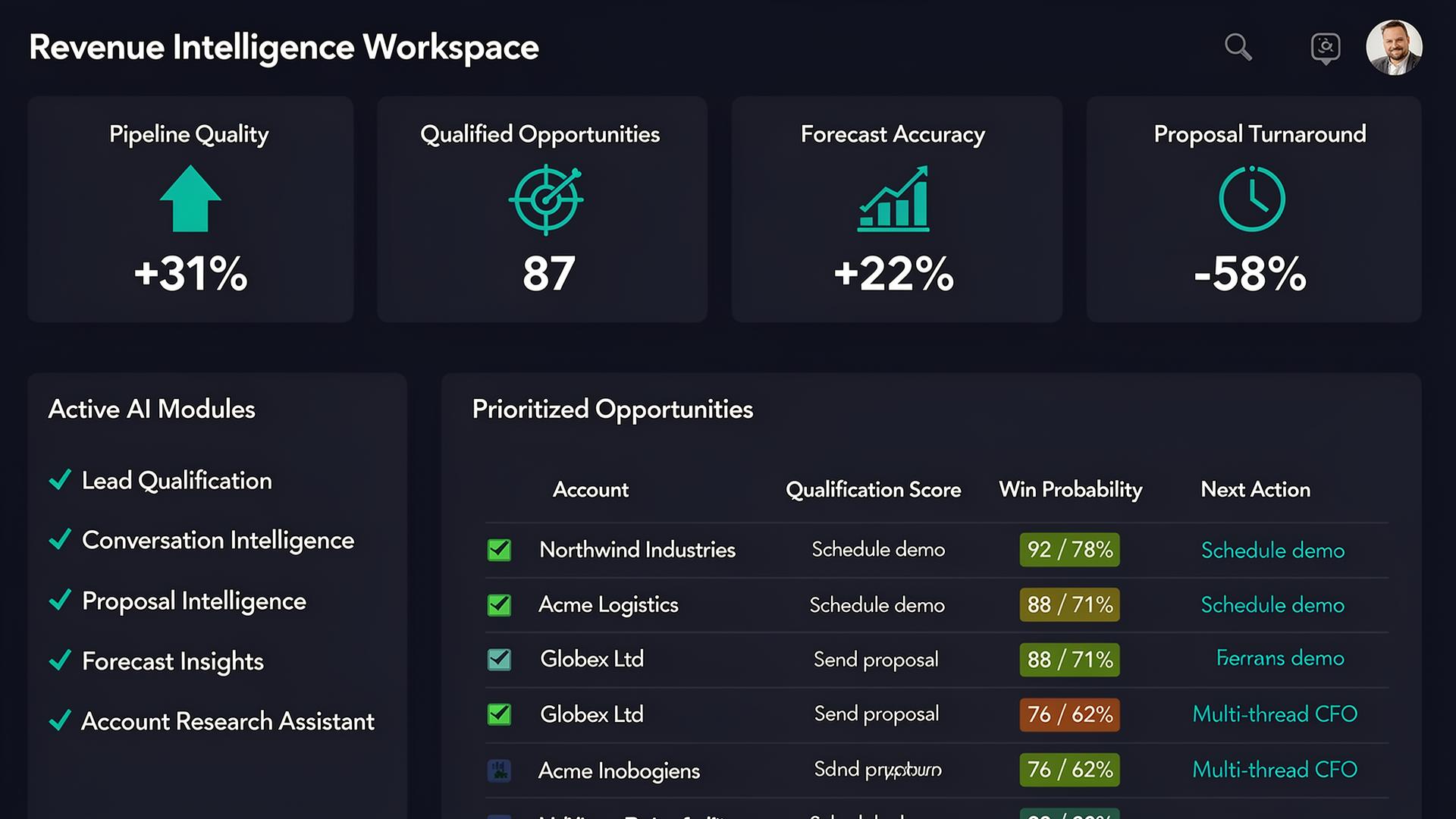
Different organisations, similar dynamics. These are the recurring patterns we see across B2B revenue teams — and the ones that AI is genuinely well-suited to solve.
Teams struggle to identify high-intent opportunities. SDRs work through inbound lists with no reliable signal of who's likely to close.
Sales teams repeatedly create content that already exists. AEs write proposals from scratch when 70% of the material is reusable.
Pipeline reviews rely on opinion rather than evidence. Everyone knows the numbers are wrong — nobody knows by how much.
Important customer insights disappear into recordings and notes. Sales leaders review calls ad-hoc, never systematically.
Salespeople spend too much time preparing and not enough time selling. Account research happens manually, in tabs, before every call.
If two or three of these match your reality, there's almost certainly a high-leverage AI workflow we can scope in a 30-minute call.
Five areas where B2B sales organisations see measurable commercial outcomes from production AI — not lab demos.
Prioritise opportunities based on historical success patterns — with explainable scores SDRs can actually act on.
Analyse calls and surface risk, opportunity and coaching insights — turning recordings into a systematic source of revenue intelligence.
Generate stronger first drafts using previous proposals and knowledge assets, so AEs edit rather than write from scratch.
Improve visibility into pipeline quality and deal progression so commit calls are based on evidence, not optimism.
Produce structured account briefings and meeting preparation packs in minutes instead of hours.
AI helps revenue teams focus on the right opportunities. It doesn't replace the human relationships that close considered B2B deals.
How calls, emails, CRM data, proposals and meeting notes flow through an AI intelligence layer and into the hands of revenue teams.
Sales activity
Calls, emails, CRM data, proposals and meeting notes
Data processing layer
Activity normalised, structured and joined to opportunity history
AI intelligence layer
Qualification, forecasting, conversation analysis and recommendations
Decision support
Qualification, forecasting, proposal support, conversation insights
Revenue teams
Better prioritisation, faster proposals, more confident forecasts
Considered B2B sales is full of repeatable patterns hidden inside unstructured data: calls, emails, decks, notes. AI is the first technology that can read all of it cheaply and turn it into something a sales team can act on.
The most effective sales organisations are not replacing salespeople with AI. They are using AI to help teams focus on the right opportunities, improve decision-making and reduce time spent on repetitive administrative work. AI becomes a force multiplier for sales capability rather than a replacement for human relationships.
It won't replace the conversation that closes the deal. That's not what it's for.
A simplified view of how the pieces fit together — from your CRM through the AI layer into the sales workspace, with monitoring and support around it.
Production flow
Many organisations already have dashboards and reports. The harder challenge is turning unstructured sales data into actionable intelligence that helps revenue teams make better decisions. We help organisations design, deploy, host and support AI-powered revenue intelligence systems that operate successfully in production.
Focus effort on the opportunities most likely to convert, with explainable scores sellers can act on confidently.
Reduce the time spent creating sales content so AEs spend more time selling and less time formatting documents.
Make decisions using evidence rather than assumptions, with pipeline signals grounded in real activity.
Allow teams to spend more time selling and less time searching for information, drafting emails or rebuilding decks.
How AI supports each stage of the considered B2B sales motion — from first signal to closed-won.
Lead qualification
AI scores opportunities against historical win patterns
Account research
Structured briefings and meeting prep generated on demand
Sales conversations
Calls analysed for risk, opportunity and coaching signals
Proposal development
First drafts assembled from prior wins and knowledge assets
Forecasting
Pipeline quality and deal progression scored against history
Deal closure
Sellers freed to focus on the conversations that win the business
Most B2B sales engagements begin with an AI readiness assessment or focused strategy sprint. We rank opportunities against commercial value, data readiness and delivery effort before building.
A 30-minute call. No pitch deck, no slideware. If we can help, we'll tell you how. If we can't, we'll point you somewhere that can.